
Multimodal Healthcare AI
An AI system that reasons across medical images and clinical text together, not as separate, disconnected tools.
Overview
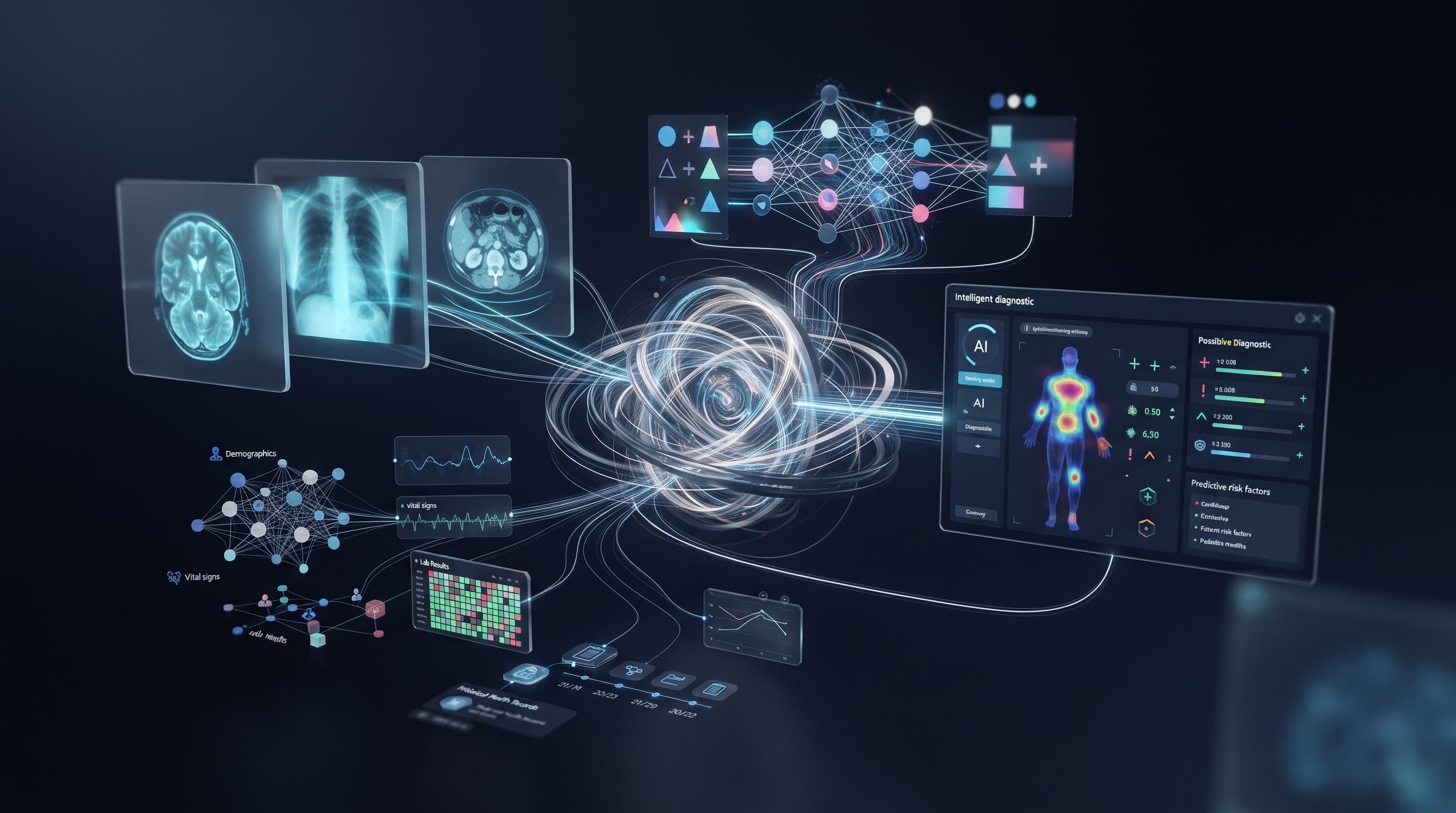
Multimodal Healthcare AI is an R&D project focused on combining multiple data types — medical images and the clinical text that accompanies them — within a single AI system, rather than analyzing each in isolation. The goal is to demonstrate how multimodal reasoning can surface insights that a single-input model would miss.
The problem
Most healthcare AI tools are built around one input type — an imaging model that only sees scans, or a language model that only reads notes. In practice, clinical understanding usually depends on both together, and disconnected tools miss the context that comes from combining them.
Our approach
The system pairs a vision component for interpreting medical imagery with a language component for processing clinical notes and context, fusing both into a shared representation before generating an output. That lets it reason about an image in light of the clinical text that accompanies it, and vice versa, instead of treating them as two unrelated pipelines.
Key capabilities
What the system actually does.
Medical Image Interpretation
Processes medical imaging data as a first-class input, not an afterthought bolted onto a text model.
Clinical Text Understanding
Reads and structures the clinical notes and context that accompany an image.
Cross-Modal Reasoning
Fuses image and text understanding into a single, context-aware output.
Structured Output Generation
Produces structured, reviewable outputs rather than an opaque single score.
How it works
System workflow.
Image & Text Ingestion
Independent Modal Encoding
Cross-Modal Fusion
Structured Output
Human Review
Image & Text Ingestion
Independent Modal Encoding
Cross-Modal Fusion
Structured Output
Human Review
Technology
Built with purpose-chosen tools.
System experience
The system is designed to sit alongside a clinician's own review, not replace it — output is presented as structured, traceable findings tied back to the specific image and text it drew from, meant to be checked rather than taken as a final word.
Why it matters
Healthcare decisions rarely rest on one input in isolation. A system built to reason across image and text together — rather than bolting one onto the other after the fact — is a more honest reflection of how that understanding actually forms.